How September Data Shapes Retailer and Supplier Holiday Plans
U.S. retail sales rose 6.3% year over year in September, but most of the gain came from gas prices; excluding gas stations, sales grew just 0.2% month over month, and CPI components diverged sharply. NRF forecasts November–December holiday sales will grow 4.2% to $1.013 trillion. Ocean freight has held steady while U.S. domestic diesel and trucking costs are rising; retailers are cutting prices while shifting cost pressure onto suppliers.
In this article you will see:
- September retail sales rose 6.3% year over year, but excluding gas stations they grew just 0.2% month over month: strong in nominal terms, weak in real terms
- Today the NRF set its November–December holiday sales forecast at +4.2%, or $1.013 trillion, a measure that excludes gasoline, diesel and restaurants
- Ocean freight has largely stabilized, while the pressure is on U.S. domestic diesel and land transport; most holiday goods have already arrived at port, and the contest now is over replenishment
Official Data Released
Between October 14 and 15 Eastern Time, three sets of official data landed almost on top of one another: the BLS reported September CPI up 3.7% year over year; the Census Bureau reported September retail and food services sales of $745.0 billion, up 0.8% month over month and 6.3% year over year; and AAA’s average gasoline price was about $4.33 per gallon (about $3.07 a year earlier). The same day, the National Retail Federation (NRF) released its annual holiday sales forecast: core retail sales for November–December are expected to grow 4.2% to $1.013 trillion (compared with about +3.1% and $972.0 billion in the same period last year); the measure excludes auto dealers, gas stations and restaurants.
The Numbers Look Good, but the Reality Is Not Strong
Gas stations rose 28.1% year over year in September, making headline retail look very bright. Core retail sales excluding autos and gas stations rose only 0.2% month over month (Census). Core CPI rose about 0.3% month over month over the same period. The University of Michigan’s preliminary October consumer sentiment reading was 46.3 (September final: 48.1), with the current conditions index at 44.7. WeCross frontline observation: income and nominal sales still tell a story, but after stripping out gas prices and inflation, unit growth is very weak, and the holiday season looks more like “the budget is back, but people aren’t buying more gifts.”
Holiday-related CPI components diverged sharply (BLS, September): candy +7.7%, jewelry +11.8%, apparel +3.4%, food away from home +3.5%, toys +6.6%, eggs −20.6%, poultry overall about +1.1%, chicken about −0.6%.
Freight: Ocean Is Stable, U.S. Domestic Is Expensive
The Drewry World Container Index (10/15) was about $4,485 per FEU; Shanghai–Los Angeles about $7,884 and Shanghai–New York about $10,075. The NRF/Hackett Port Tracker says most holiday goods have already arrived at port, with November imports forecast at about −1% year over year. What is really pushing up landed-at-store costs is inside the U.S.: AAA diesel at about $6.32 per gallon (about $3.66 a year earlier); TD Cowen/AFS forecast that fourth-quarter truckload rates will rise 14.7% year over year, and less-than-truckload and parcel rates are also at multi-year highs or new highs. New ocean orders placed from China can hardly make it in time for Black Friday; what can be sold is mainly the goods already in U.S. warehouses.
WeCross frontline observation: On October 10, we saw rows of Christmas wreaths already on display at Costco, with a price sign showing a Disney pre-lit wreath at $64.99. Holiday goods are already on U.S. shelves.
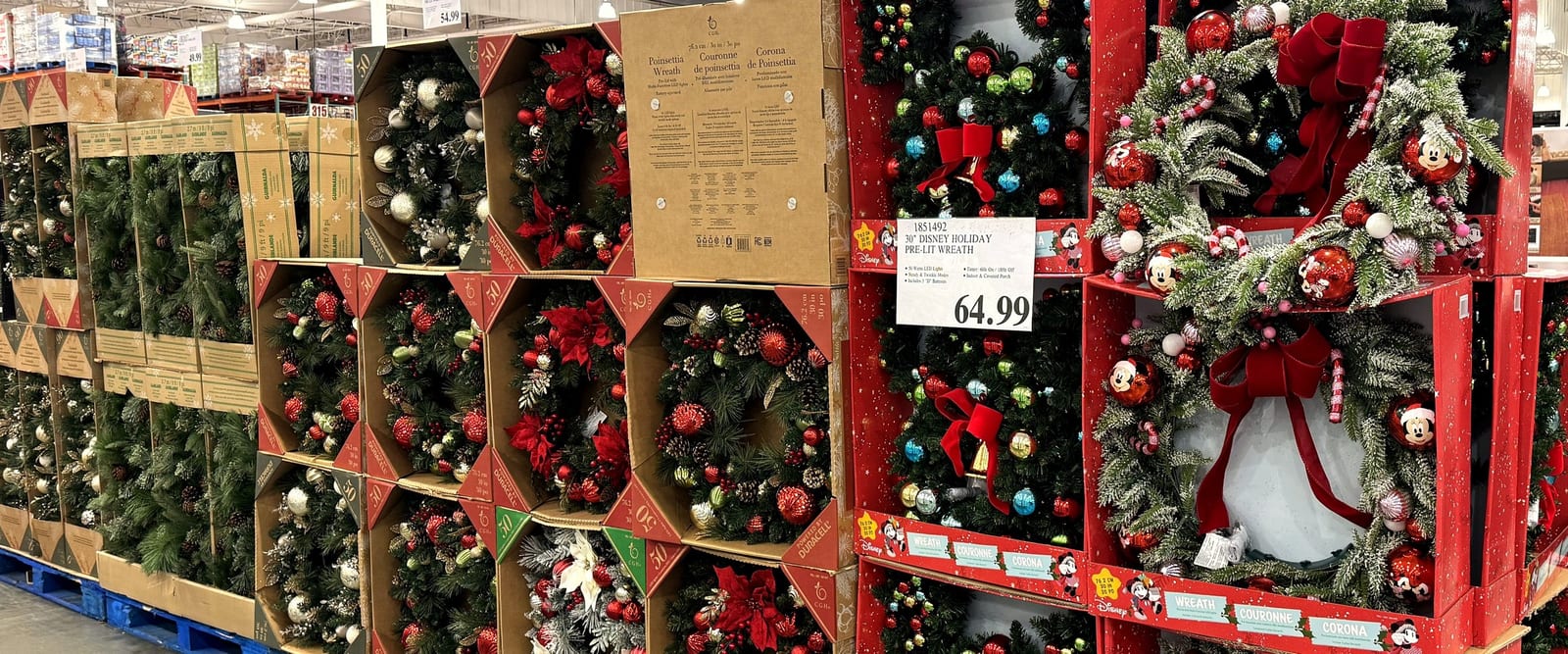
Photo: WeCross frontline observation—in early October, Costco is already fully stocked with Christmas wreaths (photo by WeCross, 2026-10-10)
Retailers Cut Prices While Squeezing Suppliers
Walmart’s management said additional fuel-related expenses this fiscal year will exceed $2 billion; Kroger’s new CEO, Greg Foran, said directly that private labels are one of the tools in the “toolbox” for dealing with price increases; if (supplier) price increases are reasonable, the team is willing to sit down and negotiate, but does not want to see anyone “come straight to the door with a price increase but without sufficient justification.” The common demands suppliers face are: lower purchase prices or more promotional funding, stricter on-time delivery, and smaller, more fragmented and more urgent replenishment orders. The NRF still forecasts growth for the coming holiday sales season, but part of that growth reflects inflation, consistent in direction with the view of Bain, Coresight and others that “record sales do not mean more goods are being bought.”
For more analysis and recommendations on 2026 holiday spending, see our article “U.S. Holiday Spending Trends in 2026”.
This document is a compilation of market information and does not constitute investment or legal advice.