October 8: White House Proposes a $70,000 OPT Fee; Labor Department Pauses PERM Processing for Eight Companies
On October 8, the U.S. Department of Homeland Security proposed a $70,000 fee for an initial period of Optional Practical Training (OPT) and $30,000 for each subsequent period. The same day, the U.S. Department of Labor announced that it would stop accepting and processing PERM labor-certification applications from eight companies, including Microsoft. Other measures that would tighten H-1B rules are still pending.
1. Proposed OPT fee rule: Who pays, how much, and when?
On October 8, 2026, the U.S. Department of Homeland Security (DHS) published a proposed rule in the Federal Register (document 2026-20660) that would impose new fees for F-1 students' Optional Practical Training (OPT), the work authorization used for practical training before or after graduation: $70,000 for an initial period of OPT and $30,000 for each later period. For a student in a STEM field who first obtains OPT and then a STEM extension, the combined amount would be $100,000.
The school would pay the fee first. Only after payment could its designated school official (DSO) enter the OPT recommendation in the system. The proposed rule also says that a school could pass the cost to the student or the employer. DHS estimates annual fee collections of about $12.4 billion.
This is only a proposed rule; no fee is being collected yet. General public comments are due by November 9, 2026, and comments on the information-collection provisions are due by December 7. DHS would then need to respond to comments and issue a final rule, which would take effect 60 days after publication. Cornell University's international-student office notes that there is no fixed timetable for a final rule and that the process usually takes months. Law firms including Fragomen expect litigation to be likely after a final rule is issued. Students who are already on OPT, have already been approved, or have received a DSO recommendation when the rule takes effect would not owe the new fee for that period. But a subsequent OPT application after the effective date, such as a STEM extension, would still trigger the $30,000 fee. The proposal concerns OPT fees only; it does not change F-1 visa or entry rules.
WeCross on-the-ground check: On October 9, 2026, I reviewed the Federal Register page for document 2026-20660. It was labeled “Proposed Rule,” showed a November 9, 2026 comment deadline, and displayed 774 public comments at that time.
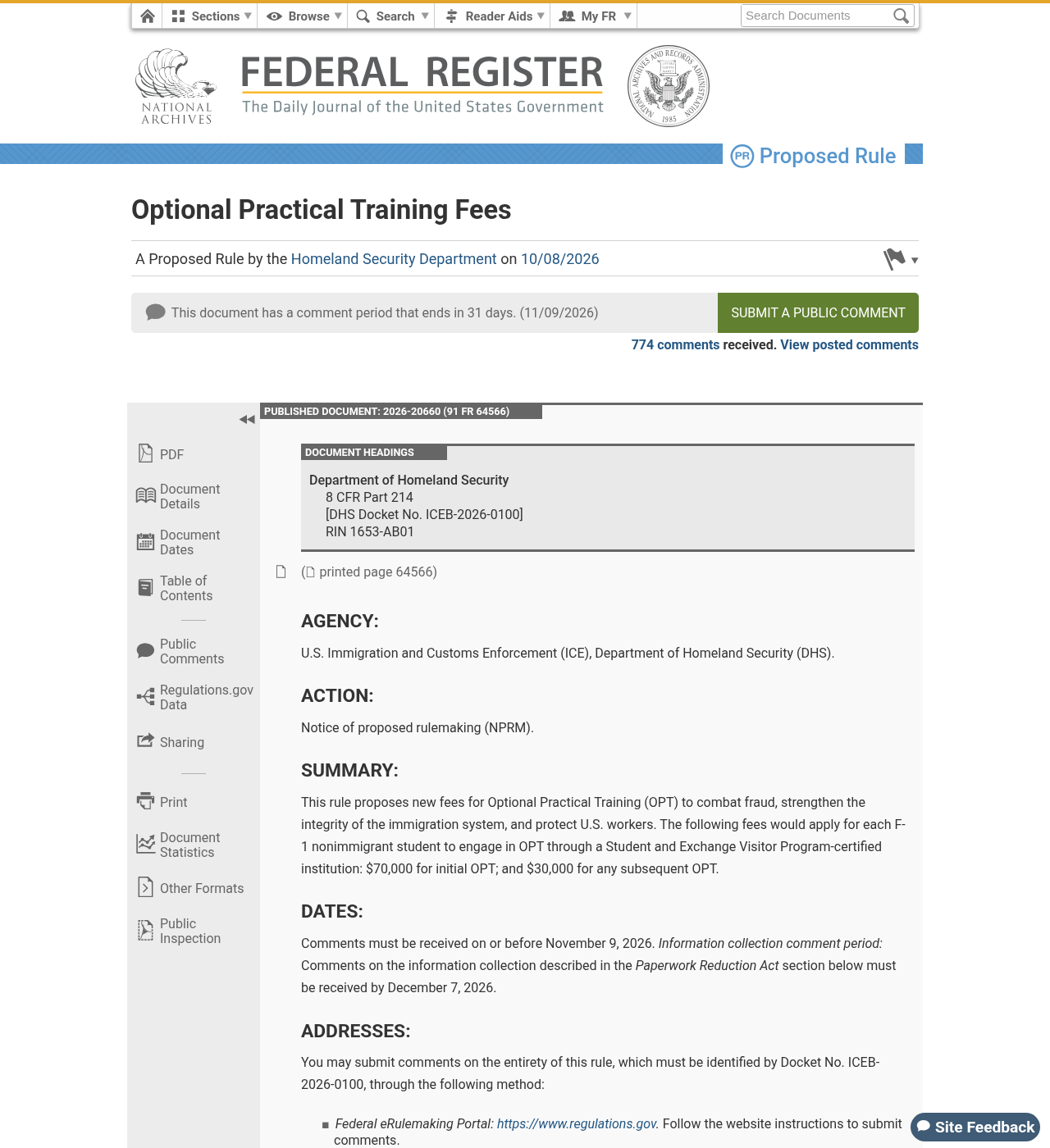
Federal Register document 2026-20660 page; accessed October 9, 2026.
2. Labor Department pauses PERM labor certifications for eight companies
At about 10 a.m. Eastern the same day, the White House held a separate news conference on work-visa fraud. Vice President Vance chaired it in his role as head of the administration's anti-fraud task force, alongside Labor Secretary Sonderling and other officials. They announced that the Department of Labor would no longer accept, and would pause processing, new and pending PERM applications from these eight companies: Microsoft, Adobe, Cognizant, Infosys, Tata Consultancy Services (TCS), Wipro, HCL, and Capgemini. Microsoft and Adobe are major software companies; the other six are IT services and outsourcing firms.
What is PERM? A PERM labor certification is the first step in most employer-sponsored green-card cases. An employer must show the Labor Department that it cannot find a qualified U.S. worker at the prevailing local wage before it can continue sponsoring a foreign employee for a green card. PERM is part of the green-card process, not the H-1B work visa itself. This announcement did not prohibit H-1B applications, although new Labor Condition Applications (LCAs) or H-1B petitions from these companies may face more requests for evidence (RFEs) or processing delays. Further rules limiting H-1B applications for certain jobs also remain possible as part of the federal effort to address H-1B abuse and protect domestic employment, particularly amid technology-sector layoffs in the AI era.
Labor Secretary Sonderling said the pause stems from fraud investigations: Microsoft and Adobe are involved in multiple federal investigations, while the other six are involved in criminal investigations led by the Labor Department's inspector general. None of the companies has been charged. This is a pause, not a revocation of eligibility to apply. Vance said it would last “as long as it takes,” without giving an end date. As of October 9, the Labor Department had not published a written announcement.
The same news conference also announced that the Labor Department's inspector general had served subpoenas on nine universities, including Harvard, Stanford, and MIT, concerning possible fraud in J-1 exchange-visitor programs. The matter remains at the investigation stage; those universities' J-1 programs have not been suspended.
3. Other H-1B tightening measures
WeCross previously reported in its Deep Research article “From F-1 to H-1B: How Policy Changes Interact Along the Employment Path” that H-1B-related fees are also changing. A presidential proclamation imposing a $100,000 H-1B fee has been extended through September 2027, but federal courts ruled on June 8 and September 30 that the fee-implementation policies were invalid, so the fee currently cannot be collected. Another proposed rule would charge about $103,265 for lottery-based H-1B petitions; it has not been finalized. See that Deep Research report for the details.
Conclusion
Taken together, the two October 8 developments point to tightening at each stage of the path from OPT during or after study, to the H-1B work visa, to PERM as the first step toward a green card. The cost and uncertainty of studying and remaining in the United States are rising. Most of these measures are still proposals, investigations, or subjects of litigation and have not been finally settled. WeCross will continue to follow them and provide regular updates.