Haidilao’s Brand Expansion in the U.S.: A Complete Analysis from Its Los Angeles Start to a Nationwide Network
How a recognizable service concept meets local expectations, locations, labor practices, and operating constraints.
After entering the U.S., Haidilao neither simply copied its restaurants in China nor gave up service as its brand core. It has kept adapting across cities, shopping districts, and regulatory settings.

Haidilao logo
1. From the first restaurant to a U.S. network
Opening date and location
Haidilao opened its first U.S. restaurant in 2013 in Arcadia, Los Angeles County, California.
Restaurant count and geography
As of September 2026, publicly available restaurant directories indicate that Haidilao has about 14 U.S. locations. The precise number changes with openings and adjustments, and third-party lists sometimes disagree; the official location page is the best reference.
Greater Los Angeles currently has four locations—Arcadia, City of Industry, Irvine, and Century City (at Westfield Century City on Santa Monica Boulevard). There is also a San Diego location. In the Bay Area, Fremont and Cupertino have restaurants. A planned Daly City restaurant at Serramonte Center, whose disclosed area is approximately 7,156 square feet, has not yet opened. Public information as of mid-2026 indicated that construction was under way, with no opening date announced. The Seattle area has two restaurants, one downtown and one in Bellevue.
Haidilao opened its first East Coast restaurant in Flushing in 2019, followed by Chicago in 2020 and Texas in 2021. The Texas restaurants are in Frisco, part of the Dallas metropolitan area, and Katy, part of the Houston metropolitan area. Around fall 2025, it opened Arizona’s first location at Mekong Plaza in Mesa, extending the network into the Southwest.
Company and international operations
Haidilao’s international operating unit is called Super Hi International. It was spun off in 2022 and listed independently in Hong Kong in December of that year under stock code 9658.
As of December 31, 2025, Super Hi operated 126 company-owned Haidilao restaurants across 14 countries. Twenty-two were in North America, including the United States and Canada.
Financing and valuation
Super Hi listed American depositary shares on Nasdaq in May 2024 under the symbol HDL. The offering price was $19.56 per share; the offering raised approximately $52.7 million and implied a valuation of about $1.26 billion.
2. Preserving the brand while adapting locally
Service standards and brand identity
Haidilao’s core proposition is exceptionally attentive service and the overall guest experience. It has included complimentary snacks and fruit while customers wait, hair and shoe-care services, toys, and children’s waiting areas. In the United States, some offerings have been adjusted to local licensing and legal conditions; for example, certain nail and massage services offered during waits have been removed or simplified.
Location strategy
In the United States, Haidilao generally chooses busy shopping centers, commercial streets, or large malls near residential areas rather than concentrating only in Chinatowns or other Chinese communities. The aim is to reach mainstream non-Chinese customers. The planned Daly City restaurant reflects this approach, though it remains under preparation or construction and has not opened. Existing locations such as Mekong Plaza in Mesa likewise follow a commercial-district or plaza strategy rather than a Chinatown-only model.
Menu and setting
Haidilao retains the essentials of Chinese hot pot—broths, ingredients, and dipping sauces—while adjusting spice levels, broth options, and ingredient choices to local preferences. Restaurant design and service processes also emphasize atmosphere, visible cleanliness, and transparency in ways that address U.S. expectations for hygiene, safety, and experience. Some locations invest in spacious, contemporary interiors, lighting, customer flow, and waiting areas.
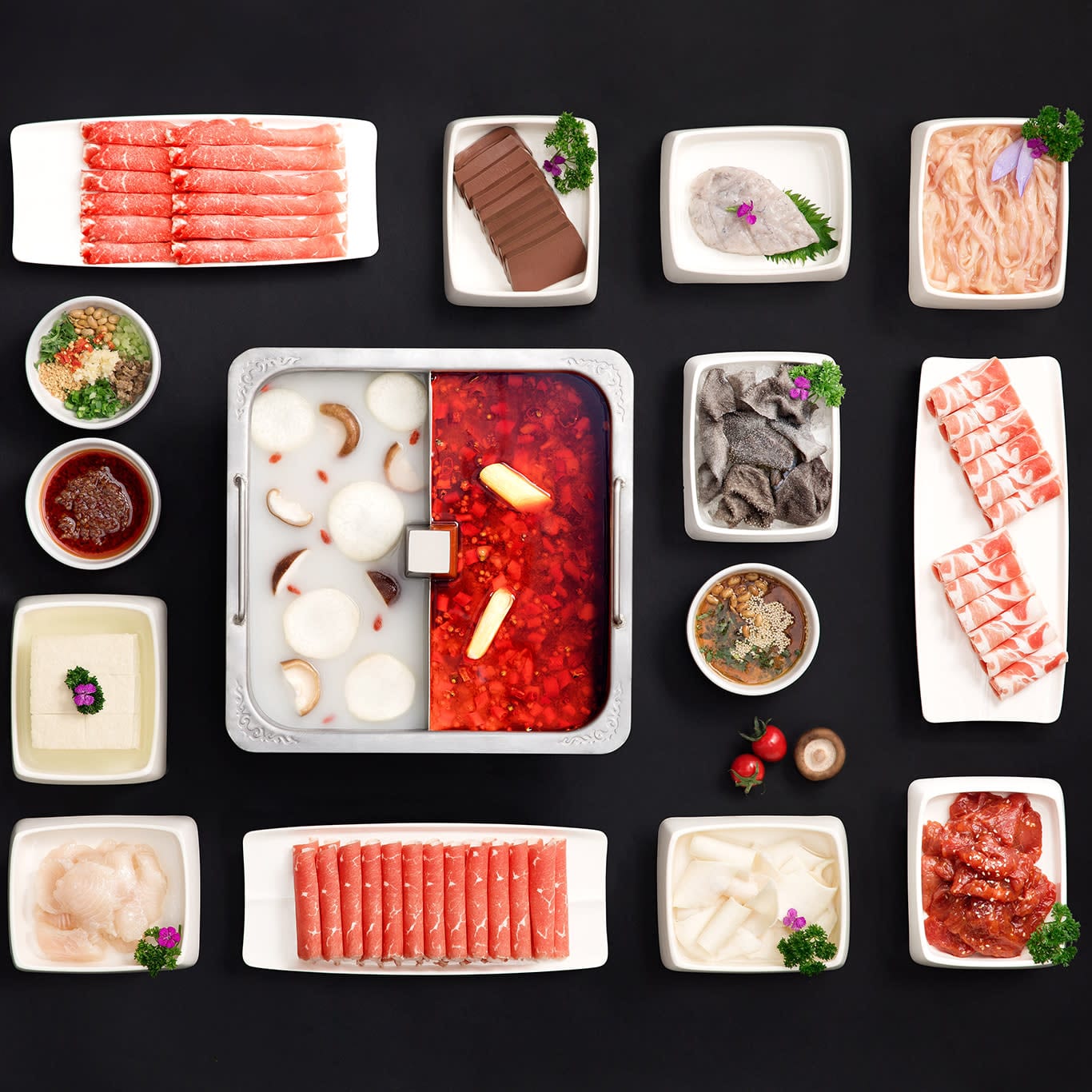
Haidilao hot-pot spread
3. Operations, food safety, and cold-chain detail
Food safety and supply-chain controls
Haidilao follows applicable U.S. food-safety requirements, including FDA rules and state or county health standards. It screens suppliers of meat, seafood, and produce, and maintains refrigerated or frozen transportation and temperature controls. Kitchen and ingredient-handling practices follow local health requirements. Visible kitchens and transparent preparation can also strengthen customer confidence.
The positive side is that, although U.S. food-safety requirements are strict, every link in the chain is well executed and managed. Suppliers operating through proper channels each fulfill their own regulatory responsibilities, such as organic certification, ingredient labeling, and allergen warnings. This division of responsibility, under which the final operator does not have to answer for every upstream link, greatly reduces the compliance burden on the final restaurant operator.
Cold chain and logistics
Ingredients reach Haidilao restaurants from multiple states and countries and often require chilled or frozen handling. Freshness and service quality are central to the brand’s reputation. Rather than building its own cold-storage network in the United States, Haidilao has used third-party partnerships to support rapid expansion. It has reportedly formed a strategic relationship with Walong, the largest Asian-food wholesaler in the U.S., using Walong’s import processes and large multi-temperature warehouses for efficient cold-chain delivery to restaurants.
Employees and the experience
Haidilao is known for both service and employee experience. Its U.S. restaurants emphasize training and standardized service processes while retaining selected Chinese-style touches, such as tableside attention, self-service sauce stations, snacks for waiting guests, and occasional entertainment such as the “kemusan” dance.
4. Lessons from the U.S. experience
The key lessons from Haidilao’s success in the U.S. market can be summarized as follows:
- A strong brand with service as the differentiator. Haidilao does not rely only on hot-pot ingredients. Above-standard attention draws guests and turns the wait into part of the brand experience.
- Locations that reach beyond one customer segment. By choosing mainstream commercial centers and malls rather than limiting itself to Chinese communities, the brand gains exposure and traffic among non-Chinese consumers.
- A balance between adaptation and identity. Spice levels, dishes, interiors, and service methods respond to the U.S. market without abandoning the essential hot-pot experience and Haidilao-style service.
- Food safety and operating discipline. Local standards, kitchen hygiene, supplier qualifications, and cold-chain management protect customer trust.
- Capital markets and an international operating platform. Super Hi’s separation and U.S. listing have increased access to capital and international visibility that can support expansion and standardized operations.

5. What other brands can learn
Other Chinese brands, including tea-drink, snack, and e-commerce food businesses, can draw several lessons from this path:
- Lead with service and experience, not only a product. The customer experience can create differentiation and loyalty.
- Do not confine location strategy to Chinese communities. A brand that pairs consistent experience with effective cultural communication can win non-Chinese customers in mainstream markets.
- Combine capital with operational discipline. International capital markets and an IPO can provide funding and visibility, but restaurant operations and employee training must remain standardized.
- Keep innovating locally. Menu choices, restaurant design, and social-media marketing require ongoing adjustment. Success in China cannot simply be assumed to replicate in the United States.
6. Conclusion
Haidilao’s U.S. expansion did not happen all at once. It has advanced step by step through a combination of brand identity, high standards, local adaptation, capital, and operating resources. From its first Los Angeles-area restaurant to further Bay Area openings, mainstream mall locations, and an international public listing, the path illustrates how a Chinese restaurant brand can move from serving primarily Chinese diners toward becoming a cross-cultural dining brand. Other Chinese brands that absorb these lessons may be better positioned to establish themselves in the mainstream U.S. market and achieve lasting international brand growth.