Retail Giants Go All Out: What’s Different About This Year’s October Deals
America’s fall sales are underway! As retail giants go head-to-head, whose playbook is more aggressive this year?
WeCross Analyst | October 5, 2026
Tags: promotions; Walmart; Target; Amazon; Prime Day; Deal Days
Introduction: What’s Different This Year
As the first week of October 2026 begins, Amazon, Target and Walmart are launching their major sales simultaneously and at full force. The backdrop is unusual: the Federal Reserve has just raised interest rates to curb inflation, oil prices remain high, and the tariff war continues to fluctuate.
Amazon’s October sale has been a regular fixture since 2022. Target has followed from the Deal Days era, which already had an autumn edition in 2021, through today’s Circle Deal Days. Walmart joined in with Holiday Kickoff in 2023 and has extended its campaign to a full week this year. The first week of October has long become the first half of online Black Friday. But this year really is different: the dates are closer, customer acquisition tactics are more aggressive, and the three retailers increasingly resemble a free-for-all.
Amazon Prime Big Deal Days, October 6–7: one of the two annual major Prime-member sales, lasting 48 hours across 35 categories. Technology deals offer up to 30% off, with Apple, Amazon Fire, Bose, Sony, Meta and JBL all participating, alongside expanded beauty, fashion and home offers. The event is exclusive to Prime members, whose U.S. membership costs $14.99 a month or $139 a year, concentrating traffic among consumers with strong purchase intent.
Target Circle Deal Days, October 6–7: announced on September 15, this member sale offers the same prices online and in stores. Free Target Circle members can participate, while paid Circle 360 members gain access a day early on October 5. Discounts reach 60% off: family apparel at 60% off, Threshold furniture at 30% off, Dyson vacuums and toys—including Barbie and Monster Jam—at up to 60% off, laptops at 60% off, beauty and personal care at 30% off, and Vera Bradley at prices as low as 65% of the original price. Target is also offering newly registered members 15% off their first order from September 27 through October 5 to drive acquisition. With sales recovering, gross margins improving and its stock surging this year, Target is well supplied and determined to win.
Walmart’s autumn sale, October 5–11: the earliest start and longest campaign of the three, lasting a full week. This is the first major battle since new Walmart CEO John Furner took office, approached with confidence and little room for failure. Unlike Amazon and Target, Walmart requires no membership; Walmart+ members receive only a few hours of early access. Official previews advertise up to 50% off home products, 60% off fashion and technology, and 70% off toys, with groceries, appliances, personal care and Halloween products also included.
| Platform | Dates | Membership requirement | Discounts | Main categories |
|---|---|---|---|---|
| Amazon Prime Big Deal Days | October 6–7, 48 hours | Prime members only | Up to 30% off technology | Technology, beauty, fashion, home |
| Target Circle Deal Days | October 6–7; Circle 360 early access October 5 | Free Circle membership | Up to 60% off | Apparel, furniture, Dyson, toys, beauty |
| Walmart autumn sale | October 5–11, a full week | No membership required | Up to 50% off home products | Home, fashion, technology, toys |
How the Spending-Capture Playbook Evolved
Amazon: From Once a Year to Twice a Year
1. Launch and experimentation, 2015–2017: Amazon introduced Prime Day on July 15, 2015, to celebrate its 20th anniversary. Early category confusion and instantly sold-out headline deals earned it comparisons to a clearance sale, but its extraordinary customer acquisition results convinced Amazon to make it a core branded event.
2. An accidental discovery, 2020: the pandemic pushed Prime Day into October, on October 13–14. That accidental shift showed retailers that consumers were willing to spend their year-end holiday budgets as early as October.
3. Twice a year, 2022 onward: the Prime Early Access Sale on October 11–12, 2022, became the recurring Prime Big Deal Days from 2023. The roles are clear: July emphasizes back-to-school spending and technology upgrades; October is a Black Friday advance campaign, bringing demand forward to relieve November’s logistics and warehousing peak.
Target: How a Follower Refined Its Approach
1. The Deal Days era, 2019–2022: digital promotions in July and October designed to intercept Prime Day, with an autumn edition already in place in 2021.
2. Rebranding and institutionalization, from 2023: folded into the membership ecosystem and renamed Target Circle Week / Circle Deal Days, the events became recurring campaigns held several times a year.
3. Three years of timing strategy: in autumn 2023, Target started nine days before Amazon, October 1–7 versus October 10–11; in 2025, it started two days earlier and covered Amazon’s entire event, October 5–11 versus October 7–8; in 2026, the dates match exactly, October 6–7. From intercepting spending early to close-quarters competition, the gap has narrowed year by year. See the chart below.
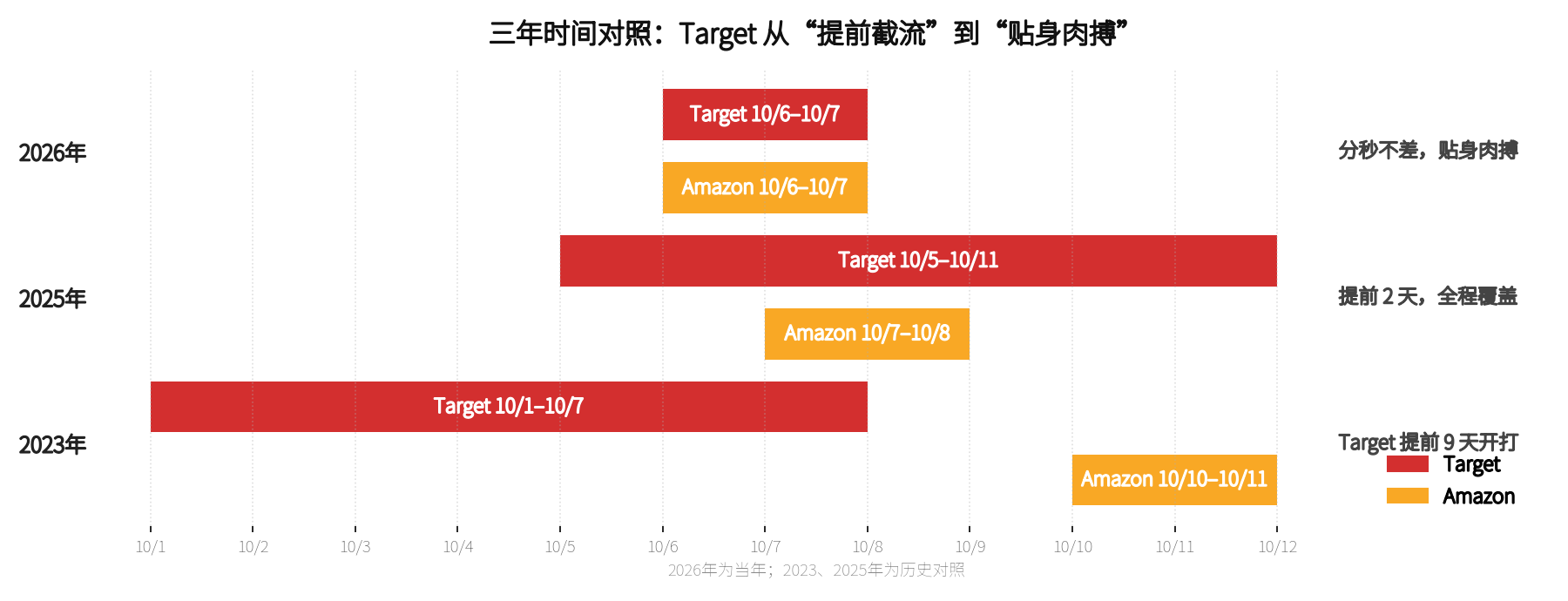
Three-year timing comparison: Target moves from early interception to head-to-head competition
Walmart: Capturing Traffic Without a Membership Barrier
Walmart joined with Deals – Holiday Kickoff on October 9–12, 2023. In 2026, it runs for a full week, October 5–11, with no membership required and only a few hours of early access for Walmart+ members. The logic is straightforward: Amazon places a $139 annual Prime fee at the entrance; Walmart removes the barrier to attract price-sensitive consumers reluctant to renew Prime.
The core logic is simple: the fourth-quarter wallet is only so large, and whoever empties it first wins. Lock in holiday budgets in October, and by November’s Black Friday consumers’ cash flow and shopping needs have already been drawn forward.
What’s Different This Year
1. Timing: From Early Interception to Head-to-Head Competition
Target has steadily tightened its timing over three years, as the chart shows: nine days early in 2023, two days early in 2025, and exactly the same dates in 2026. Walmart has taken the opposite approach, running from October 5 to October 11 to capture spending both before and after its rivals’ events.
2. Membership Battles and Pressure Across the Board
Amazon:
Access stays behind the paid Prime wall, but the traffic is both expensive and high quality.
Target:
Free Circle membership removes the entry cost, while the sale becomes a major campaign for paid Circle 360 membership at $99 a year. Circle 360 members enter 24 hours early on October 5; new annual memberships receive $50 in rewards, and newly approved Circle Cards receive $75.
A powerful Own Brands advantage: unlike Walmart’s focus on standardized technology products and appliances, Target’s strongest weapon is its high-margin owned home and apparel brands. In this sale, Threshold, Hearth & Hand with Magnolia for home products, All in Motion for activewear, and Cat & Jack for children’s clothing offer substantial discounts of 30%–40%. Competitors cannot replicate this exclusive assortment. (Editor’s note: Target’s depth of operation and reliance on its own brands far exceed those of most peers. They are truly its profit center and a defensible core business. Target consistently calls them Own Brands rather than the more common terms private brand or private label. We may devote a separate article to this topic later.)
Far greater online–offline integration than Walmart: Walmart’s Fall Deals are predominantly online, whereas Target is closely synchronizing all its U.S. physical stores with Target.com and its app. Shelves, end-caps and digital screens carry Circle-exclusive discount signs. Combined with Target’s signature Drive Up service, which brings purchases to the car’s trunk, in-person shopping and store-based fulfillment are much more active than at Walmart.
The central aim: promoting the reorganized paid Target Circle 360 membership. Target is using this promotion to drive its Amazon Prime competitor, Circle 360, at $99 a year with same-day delivery as the core proposition. Ordinary customers can access event prices through free Circle membership, but paid 360 members receive both exclusive early entry on October 5 and additional rewards subsidies, creating powerful commercial leverage.
Walmart:
Maximum duration—a full seven days: Amazon’s Prime Big Deal Days generally concentrate on October 6–7, whereas Walmart runs from October 5 through October 11, capturing spending before and after the rival event and giving consumers more decision time.
No entry barrier versus Amazon’s Prime model: most of Amazon’s best autumn deals are restricted to paid Prime members, while Walmart offers promotional prices to everyone without a membership requirement. This makes the campaign feel more widely visible and accessible to many nonmembers.
Deep participation by third-party Marketplace sellers: similar Walmart promotions previously focused on first-party clearance or standardized products. Over the past two years, Walmart has increased traffic support and subsidies for cross-border and third-party merchants. This event includes large numbers of third-party home, digital accessory, pet and automotive products, taking the number of discounted SKUs to a record high. Securing orders early amid inflation: North American retail sentiment still favors value and necessities. Concerned that consumers’ budgets will tighten by late-November Black Friday, Walmart is offering many Black Friday-level discounts in October—for example, cuts of 20%–50% or more on AirPods, robot vacuums and small kitchen appliances—to capture year-end gifting budgets ahead of time.
3. Amazon’s Breakout Tactics This Year
AI and algorithms play a deeper role in shopping guidance: beyond conventional price cuts, Amazon has broadly introduced generative AI and the Rufus shopping assistant. Discount alerts are matched automatically to shoppers’ real-time intent and past cart behavior, shifting promotions from customers finding products to precisely targeted recommendations.
Staged, time-limited access replaces simple discounting: for high-ticket, high-demand products such as large Sony televisions and premium espresso machines, Amazon increasingly uses Prime-exclusive invite-only reservations and three-stage limited releases through Today’s Big Deals drops. Scarcity encourages shoppers to reopen the app frequently.
Multichannel fulfillment expands beyond Amazon through Buy with Prime: Amazon no longer relies solely on its own site traffic. Its external supply-chain services let independent-site merchants and even social platforms participate in the Prime sales event.
4. Other Retailers’ Counter-Campaigns
Beyond Walmart and Target, other major North American retailers and newer challengers are launching their own counter-campaigns this week:
| Retail giant | Promotion / action | Core approach and defensive strategy |
|---|---|---|
| Best Buy | Tech Fest / 48-Hour Flash Sale | Targets Amazon’s technology and computer stronghold through precise price matching. Plus/Total members receive an additional 60-day price guarantee on OLED TVs, Apple devices and gaming laptops with high-end graphics cards, countering shoppers’ hesitation over Amazon’s return window. |
| TikTok Shop | Super Fall Deals | Uses short videos and livestream clips to offer extremely low prices across the internet. Large platform-subsidized coupons offer up to 30%–50% off, targeting younger impulse shoppers in beauty, skincare, compact home products and fast fashion. |
| Kohl’s | WOW Deals / Flash Sale | Focuses on apparel, shoes, bedding, home textiles and small kitchen appliances. Its signature tactic is follow-up coupons, such as $10 in Kohl’s Cash for every $50 spent, pushing consumers to return for November’s Black Friday. |
| B&H Photo & Newegg | Mega Deals / Fall Tech Days | Targets high-ticket photography equipment, professional PC hardware and digital accessories. Proprietary tax-saving credit cards, such as B&H Payboo reimbursing sales tax, create a total-price advantage over Amazon. |
| Home Depot & Lowe’s | Fall Savings / Early Black Friday | Discounts large products such as outdoor trimmers, garage tools and home insulation supplies, building barriers through bulky-item warehousing, delivery and local specialist stores that Amazon cannot fully penetrate. |
Retail Rivals Battle on Every Front
If this year’s attacks on Prime Day and Amazon’s counterattacks are fiercer than before, the current environment adds more than a proportional increase in business and management difficulty for brands. Readers with questions can refer to earlier articles and in-depth research on this site:
Ocean freight costs remain unresolved: the suspension of Section 301 port surcharges is recorded in a Federal Register legal document and expires at 11:59 p.m. Eastern Time on November 9. Another 178 Section 301 product exclusions expire the same day. Whether a freight forwarder’s quote includes surcharges, and whether those charges take effect before goods reach port, directly determines the shipment’s cost model.
Enforcement is tightening: CBP continues increasing seizures involving imports using stolen U.S. business identities, counterfeit certifications such as UL and FCC, and fraud through de minimis channels. Even small defects in Importer of Record documentation or customs paperwork can cause delays or detained goods. Promotional inventory can least afford delay and uncertainty.
Small-parcel rules are changing: after October 22, postal parcels worth less than $2,500 must be declared through a licensed customs broker. Categories dependent on direct-mail parcels need to recalculate. For example, a $40 order containing two cotton T-shirts sent from Vietnam faces tariffs of approximately 29%. Timing, cost and compliance all need reassessment.
The tariff window is counting down: the U.S. tariff truce currently extends only through January 10, 2027. Every shipment being prepared now requires a clear view of the tariff environment in which it will clear customs and be sold.
Conclusion
Major sales happen every year, and the spectacle returns every year. Turning excitement into business depends on the work done beforehand. That preparation determines whether you can seize an opportunity when it arrives—and whether you ride the waves or are overturned by volatility.
We will continue following developments and bringing firsthand information from the United States to provide useful decision support for Chinese brands expanding overseas.