New Opportunity Watch: Costco Expands Its Asian Food Selection
An in-store look at frozen foods, club-pack economics, and roadshows—along with the limits of drawing national conclusions from local shelves.
In the frozen section of a U.S. Costco, Asian convenience foods are no longer an occasional token. What you see is broader displays, a clearer member-value message, and large-pack logic suited to a warehouse club.
A different-looking frozen-food aisle
Open the heavy door of a Costco freezer and the first impression is not “another dumpling SKU.” It is a whole stretch of Asian frozen convenience foods. Korean and Japanese products sit beside Wanchai Ferry and Synear, brands familiar to Chinese readers, as well as shrimp dumplings, potstickers, and yakisoba bowls in English-language packaging. Large cartons, pallet displays, and readable price tags make this a warehouse-club presentation, not a scaled-down Chinese-supermarket shelf.
For a Chinese brand, that scene conveys both an opportunity and a limit. The opportunity is greater visibility for Asian and international frozen foods in recent years. Costco management has publicly mentioned new international-food items, and regional warehouses can broaden assortments to match local demographics. The limit is that products still need to work as club packs with a clear value proposition and sufficient turnover. These are not small “Asian-style trial sizes.” A brand is competing for a slot that members consider good value and buyers believe will sell through.
This article first describes what the author saw, then compares it with public reporting, and finally considers a Costco-specific accelerator: the roadshow. Readers who need compliance requirements, pricing, or a phased checklist should use the companion research report. This piece is intentionally short and grounded in the store visit.
What was on the shelves
The author photographed a group of Asian frozen products occupying visible shelf space, not just an occasional token item. The brands and product types included:
| Visible brand | Brief in-store impression |
|---|---|
| Bibigo | Mini wontons, organic potstickers, and chicken-and-vegetable dumplings; Korean-style large packs sold by both piece count and weight |
| Wanchai Ferry | Pork-and-cabbage dumplings and other packs with visible Chinese-language information |
| Synear | Pork wontons with chili oil and other products familiar to Chinese shoppers |
| Ajinomoto | Japanese-style yakisoba and multi-bowl soy-sauce ramen packs |
| Royal Asia | Large packs of shrimp dumplings |
| Crazy Cuizine | Large-format frozen entrées such as orange chicken |
| Ling Ling | Chicken-and-vegetable potstickers and related products |
The formats consistently looked like club packs: 36-count dumplings, 48-ounce wontons, six-bowl ramen packs, and 66-ounce frozen meals. The unit-value proposition was visible on the packaging, so a member could buy enough in one visit. Shelf prices vary by warehouse and week; this article does not reproduce them as an “official price list” that might be mistaken for nationwide pricing.
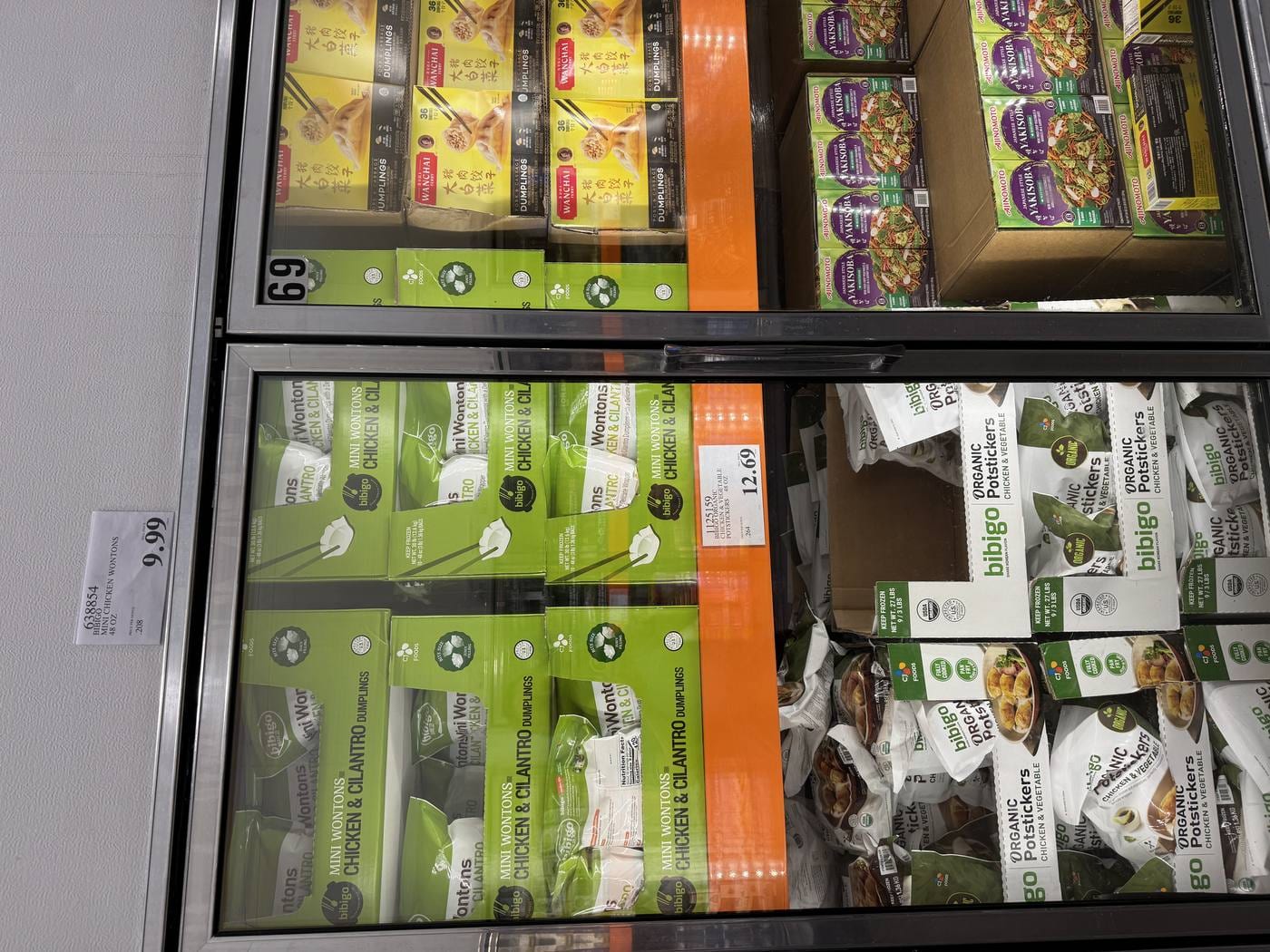
Asian frozen-food display 1: pallet display of dumplings and wontons, photographed by the author.
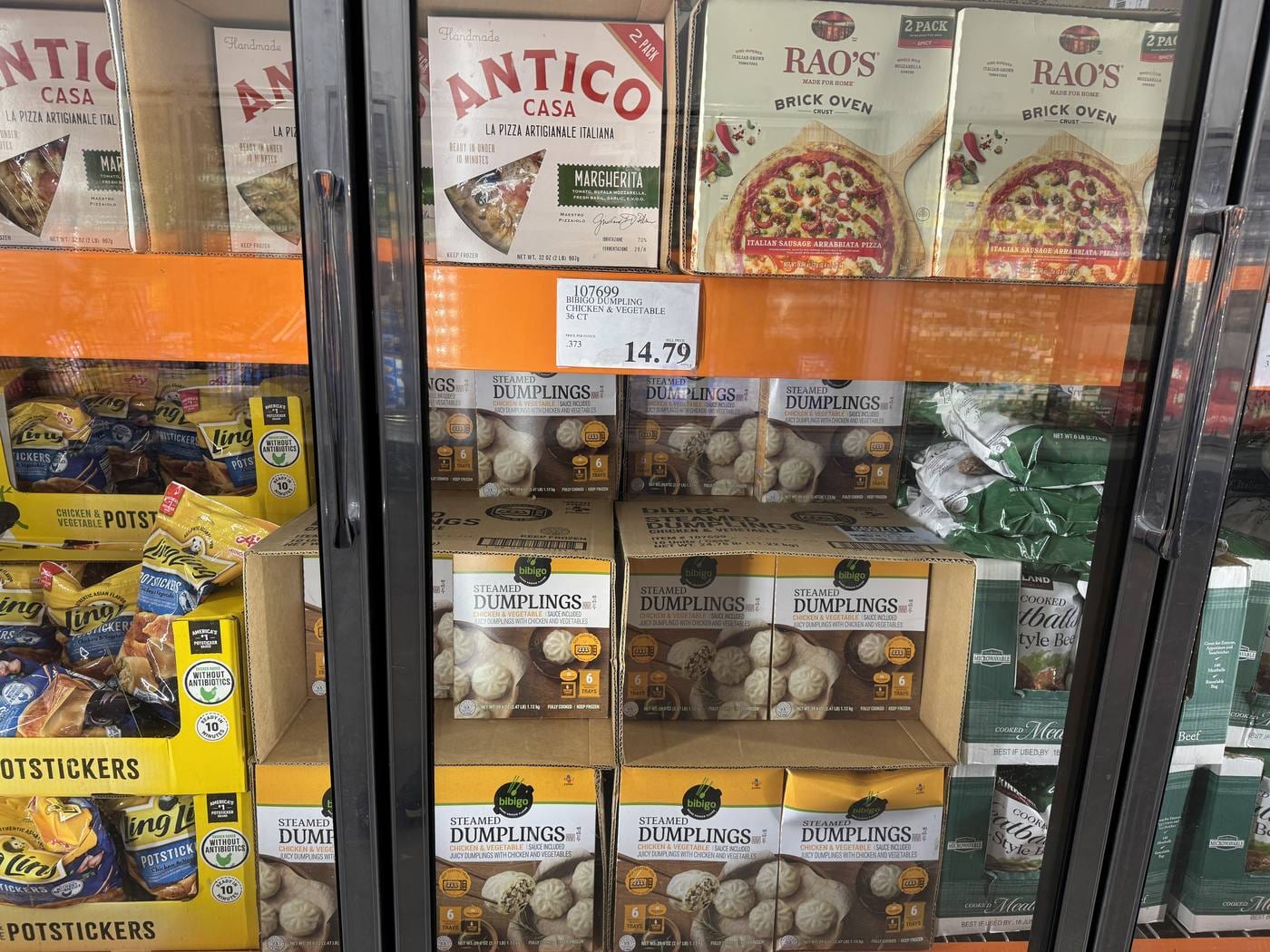
Asian frozen-food display 2: multiple brands together, with club-pack sizes clearly visible, photographed by the author.
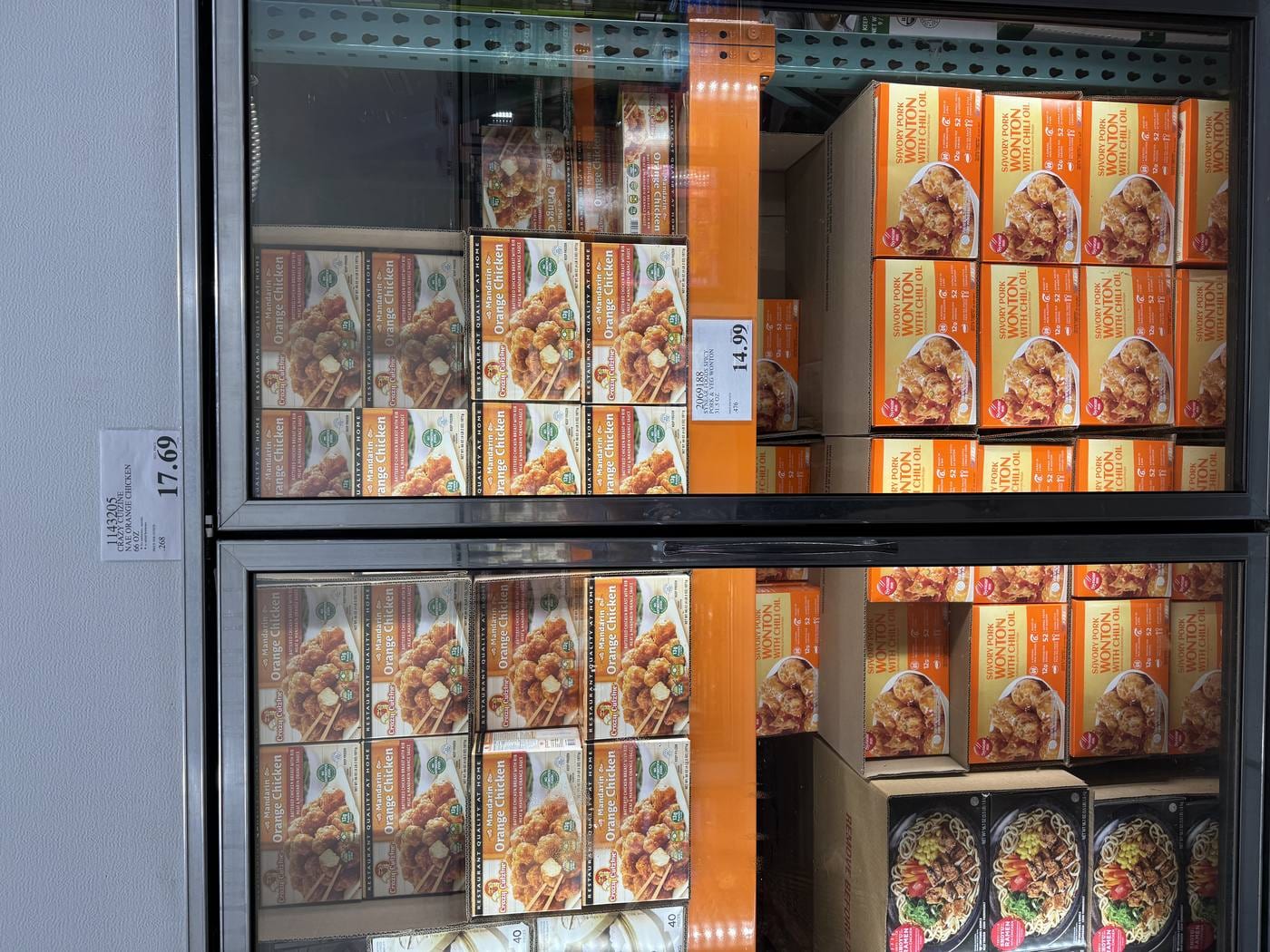
Asian frozen-food display 3: Wanchai Ferry and Synear beside Korean and Japanese products, photographed by the author.
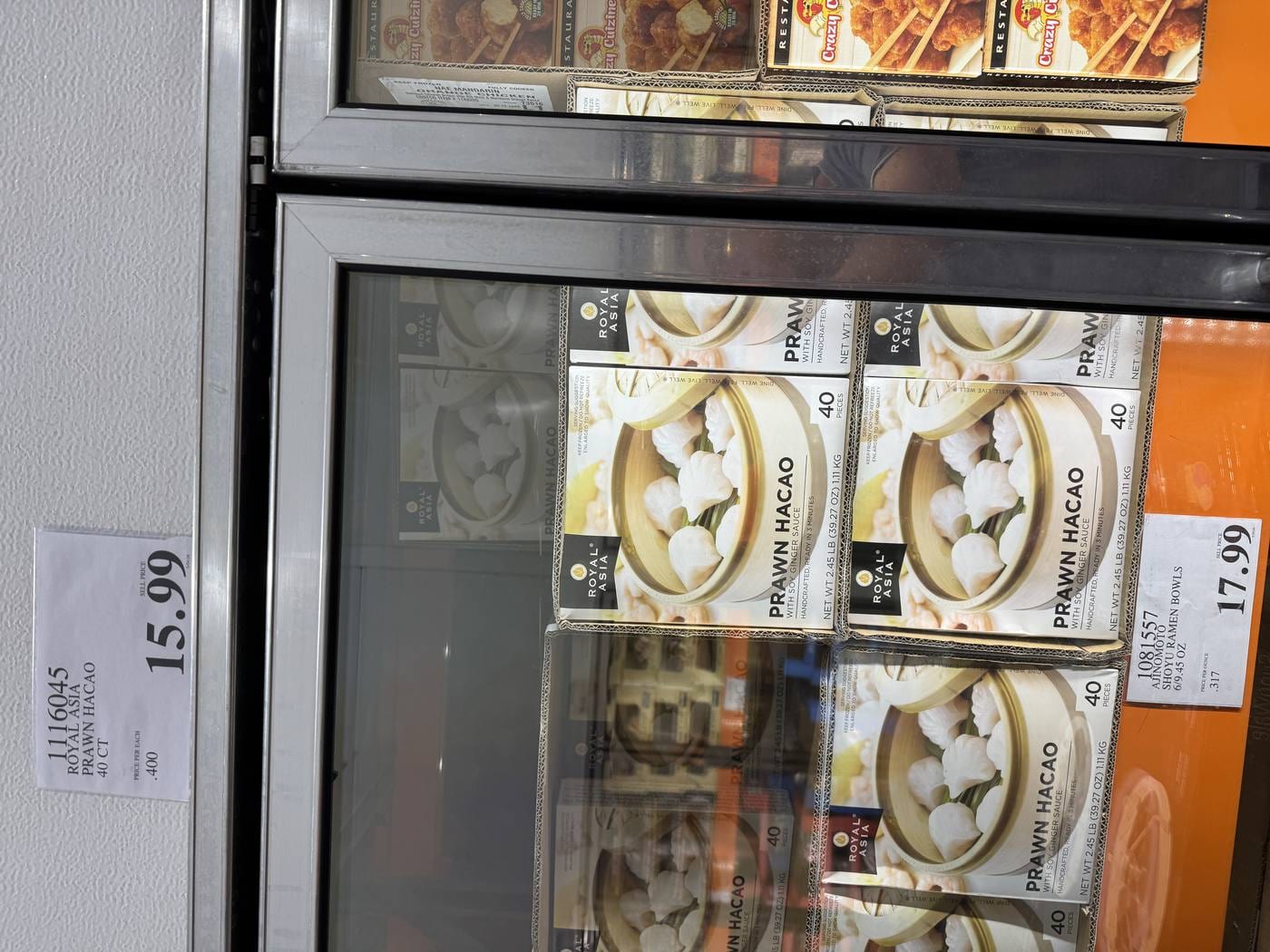
Asian frozen-food display 4: Japanese noodles beside other Asian frozen products, photographed by the author.
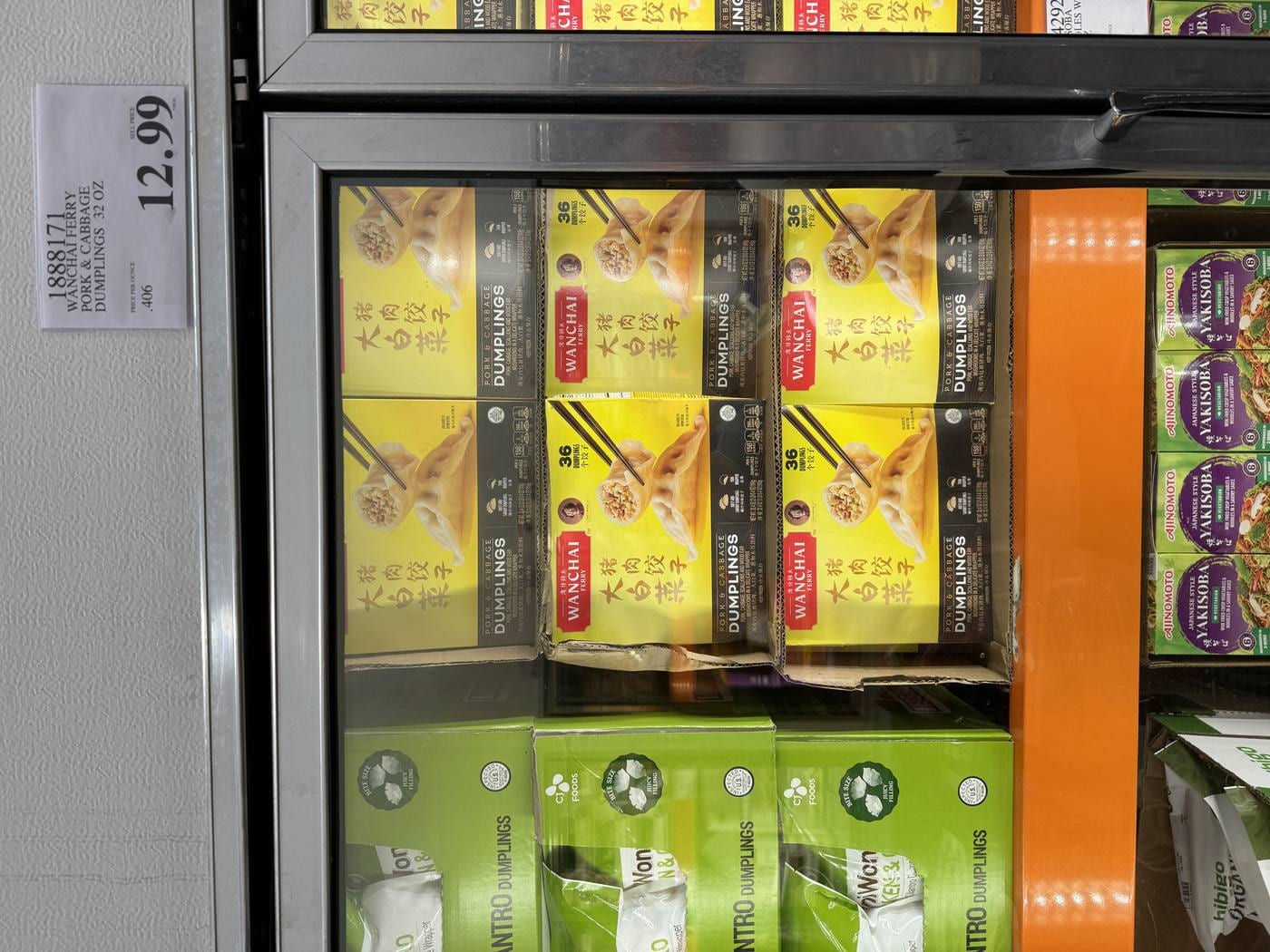
Asian frozen-food display 5: another view of the freezer, with a denser assortment than a token trial display, photographed by the author.
The limited observation supports four points:
- Asian dumplings, wontons, and noodles were displayed with consistent density at the observed warehouse.
- Pack sizes followed Costco’s logic: large formats, case or pallet presentation, and a clear price band.
- The brand mix matters. Korean and Japanese products coexisted with brands familiar to Chinese consumers. Buyers are willing to carry Asian flavors, but select items that fit the warehouse model.
- One store should not be generalized into a nationwide assortment. Regional warehouses differ with customer demographics and buyer decisions.
How public reporting compares with the shelves
Beyond the store visit, public information points in the same direction: Costco is broadening its Asian-food choices, at least in visibility and in the categories highlighted by buyers and management.
Management statements. Coverage of Costco’s quarterly performance by Progressive Grocer and others has quoted management noting momentum in new international-food items, including soup dumplings, certain rice products, and beef slices for hot pot.
Regional warehouses. The Oregonian reported in 2025 that the Aloha warehouse in the Portland area carried substantially more East and Southeast Asian foods than other Oregon locations because of its Asian-member base. It described a similar logic in Seattle, the South Bay, and Los Angeles. That is consistent with seeing a large Asian assortment in one freezer—but it is also a reminder that the first opportunity may be in the right regional warehouse.
Brand expansion. Public activity by Synear in Costco freezers has become more visible in recent years. Brand and trade-media reports have followed products from pork soup dumplings to panda buns and holiday tangyuan, and described a path from regional pilots to more U.S. and Canadian warehouses. That is consistent with Costco’s usual “regional first, expand later” pattern. Progressive Grocer also included a panda bun developed for Costco among its 2025 best new products, suggesting that buyers are not opposed to Asian frozen-food innovation with visible appeal and an easy story.
Membership patterns. An earlier CNBC article noted that Asian households are more inclined toward large formats and club shopping, while Asian specialty products and holiday displays have become more common in warehouses.
Read alongside the photographs, this supports a real window of opportunity. It does not supply a single public, nationwide figure for “the rate of growth in Asian-food introductions.” A restrained business plan is more useful than an invented attractive percentage.
A roadshow beside the shelves
In the main aisle near the frozen section, the author photographed a temporary LAOBAN sampling booth. Product shelves stood behind it. Staff wore hairnets and gloves and distributed heated samples in small cups—a familiar warehouse food-demonstration format. The banner used English-language claims about bold Asian flavors and quick preparation. The packaging was contemporary and multipack, with the warehouse-club price band visible on the tag.
The demonstration and stocked product were in the same place. Members could taste and then turn around to put the larger pack in their carts. For dumplings and buns whose flavors may need an introduction, that is more effective than a silent listing.
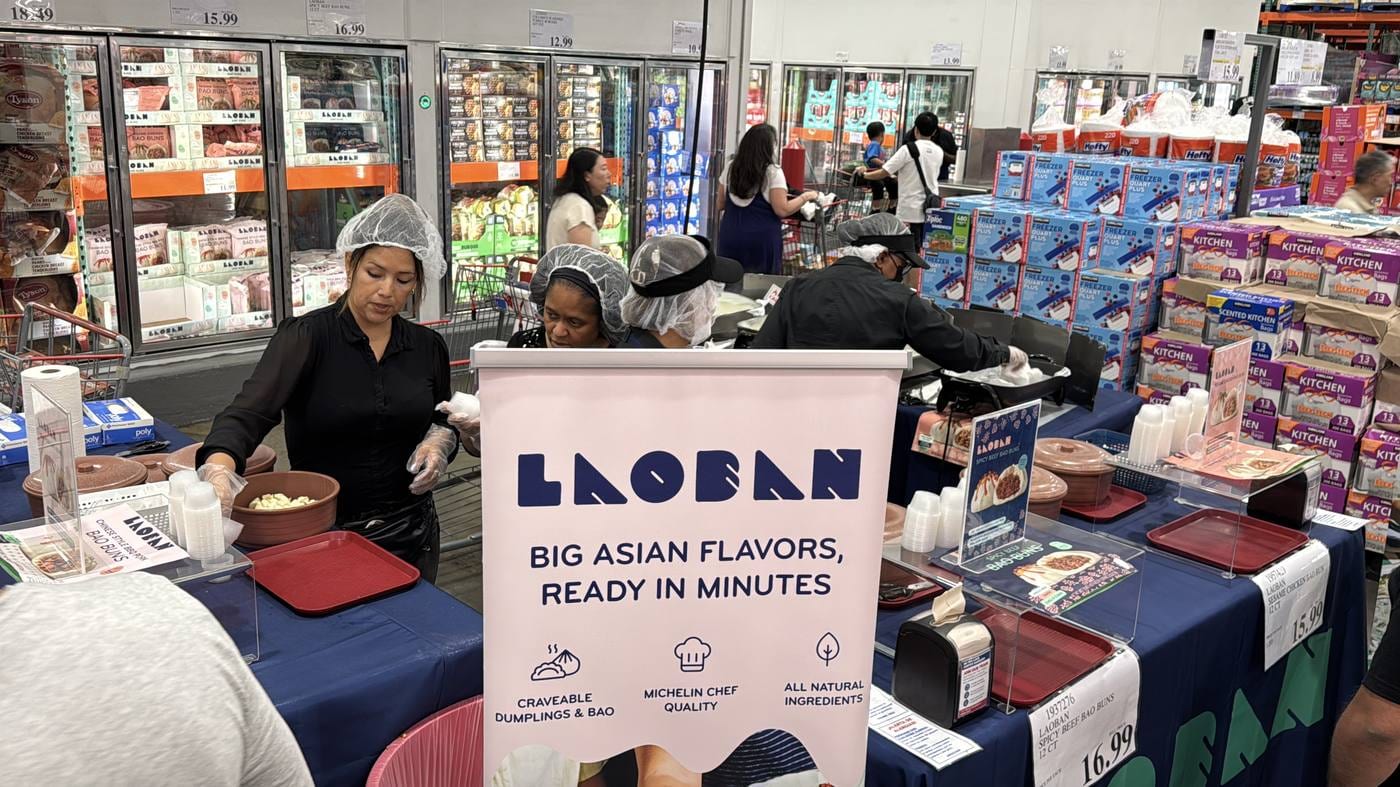
LAOBAN roadshow sampling booth in the main aisle, with stocked product behind it, photographed by the author.
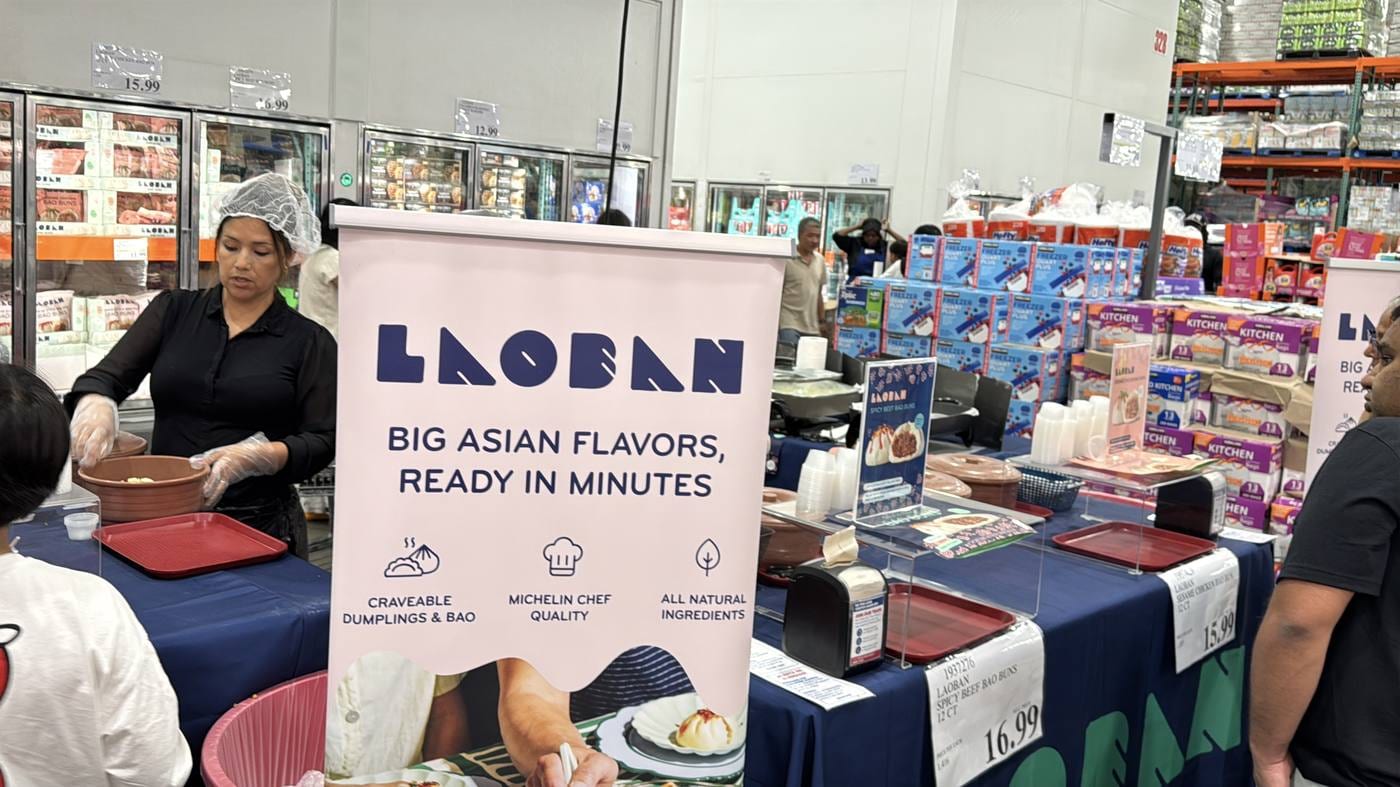
LAOBAN products and English-language banner in the same frame, photographed by the author.
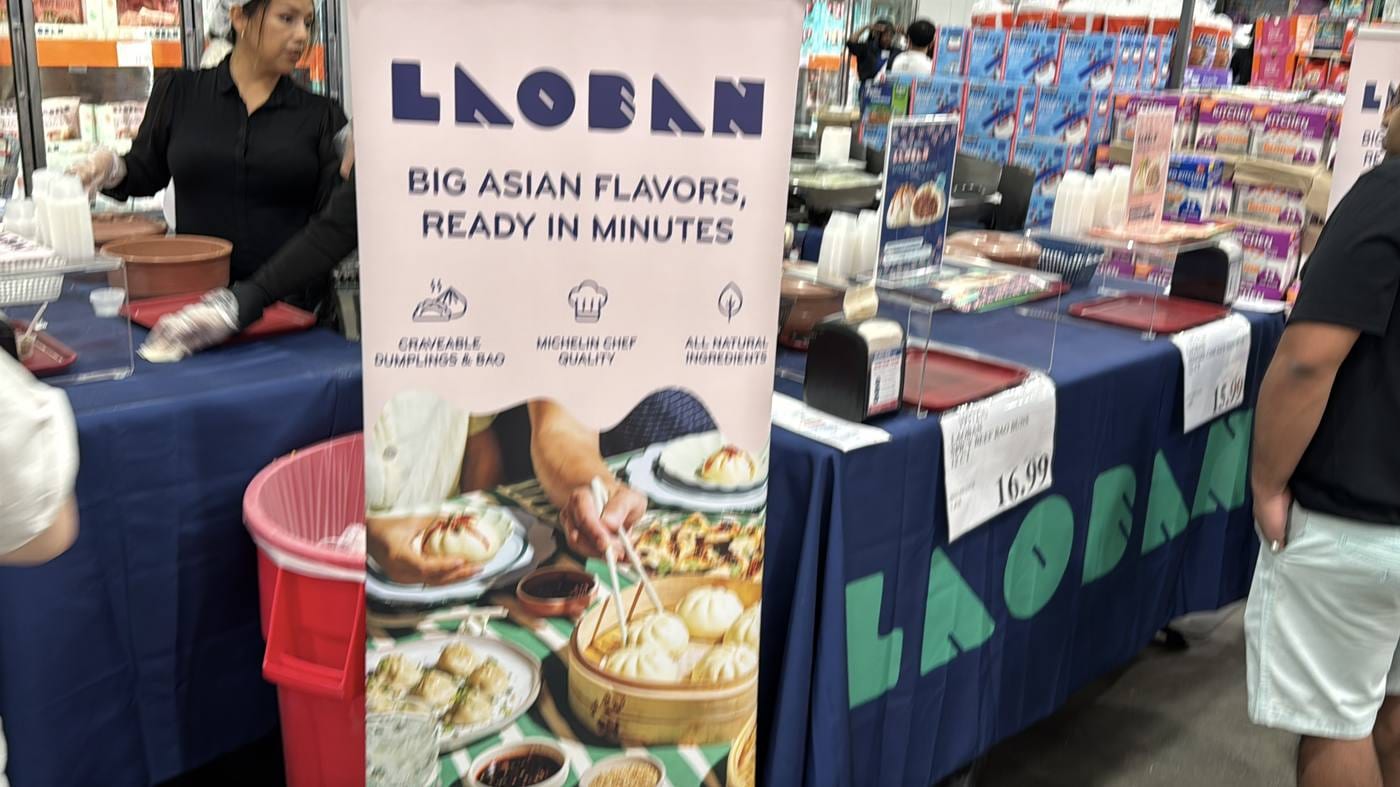
Staff heating and distributing samples in hairnets and gloves, photographed by the author.
On the member side, Costco calls such events Special Events or Roadshows: a temporary main-aisle selling and sampling program, commonly lasting several days to roughly two weeks, where large packs can be sampled and purchased. Members can search schedules by region on the customer-service site.
Brands often describe roadshows as a way to prove demand and pursue more reliable shelf placement. That is a brand’s account, not a Costco promise of entry. Public examples from North American dumpling and Asian frozen-food brands describe expansion to more warehouses after multiple roadshows. The pattern is instructive, but another brand’s numbers should not be pasted into your own forecast.
Three uses for a roadshow: an accelerator, not a shortcut
Based on the store visit and how the program publicly works, it is more useful for Chinese brands to think of a roadshow as having three uses, not as the only ticket in:
1. Before becoming a regular supplier, test whether members buy
A roadshow can demonstrate short-term sell-through, conversion from sampling, and member feedback. It gives a buyer a direct answer to “Will members actually buy it?” But the schedule and product supply still generally require buyer approval; this is not a self-service booth booked by filling out a form. Spending on a demonstration before speaking with a buyer may produce one lively day and a pile of unsold inventory.
2. As an existing supplier, build more sales
Sampling can introduce a new product, support a holiday season, or lift velocity when a competitor occupies nearby space. The combination visible at the LAOBAN event—stock on shelves plus sampling in the aisle—normally rests on an existing arrangement concerning buyers and assortment.
3. Move from one region toward more regions or a national presence
After a regional pilot works, multiple roadshows and sell-through figures can support negotiations for more warehouses. Public examples of Asian frozen-food brands often follow “a few roadshows or one regional assortment first, then broader distribution.” That fits Costco’s narrow-SKU, prove-before-scaling logic.
One rule should remain explicit: an accelerator is not a substitute for a buyer agreement and a formal purchase order. Without a supply agreement, insurance, factory review, and orders, even a busy roadshow is just an expensive exhibition. Costs, hygiene documents, and the execution partner—often a company such as CDS—should be confirmed in writing with the buyer. This article does not repeat possibly outdated daily-fee tables that could mislead a quotation.
For fuller entry routes, compliance thresholds, and financial examples, read the companion research report. The purpose here is to make clear that the shelves are widening and that the roadshow is part of the conversation.
Three takeaways for brands
1. The opportunity is real, but the format belongs to Costco. Greater visibility for Asian frozen foods does not mean an Amazon-sized small pack will work on a club shelf.
2. A first regional launch is often more realistic than a national one. Warehouses serving different populations can carry very different ranges; both public reporting and this store visit point to that distinction.
3. If the flavor needs an introduction, evaluate a roadshow seriously—but do not spend on one before engaging a buyer.
To turn the opening into orders, begin with Vendor Inquiries, regional buyers, or a credible broker. Prepare the club pack, landed cost, and readiness for review. The companion report contains the details.
Further reading
Research on How Chinese Brands Can Enter Costco in the United States, by Brian Liao: the complete entry path, compliance requirements, and financial framework.